Talking with Dr. Olivia
Dr. Olivia is a Socratic tutor — she's at her best when you treat her like a study partner, not a search engine. Ask open questions, think out loud, push back, request examples. The more conversational you are, the better the session.
What She Does Well
- Concept walk-throughs. "Walk me through preload, afterload, and contractility — I keep mixing them up."
- Scenario reasoning. "A 62-year-old comes in with sudden chest pain radiating to the left arm. What should I be thinking about and why?"
- Quizzing. "Quiz me on the 12 cranial nerves — ask me one at a time and tell me if I'm right."
- Clarifying confusing material. "My textbook says X but the lecture said Y. Help me square those up."
- Drawing diagrams. See Image Generation — just ask her to sketch it.
- Looking up your course materials. "What did Dr. Smith say about the JAK/STAT pathway in last week's lecture?"
How to Phrase Things
| Less effective | More effective |
|---|---|
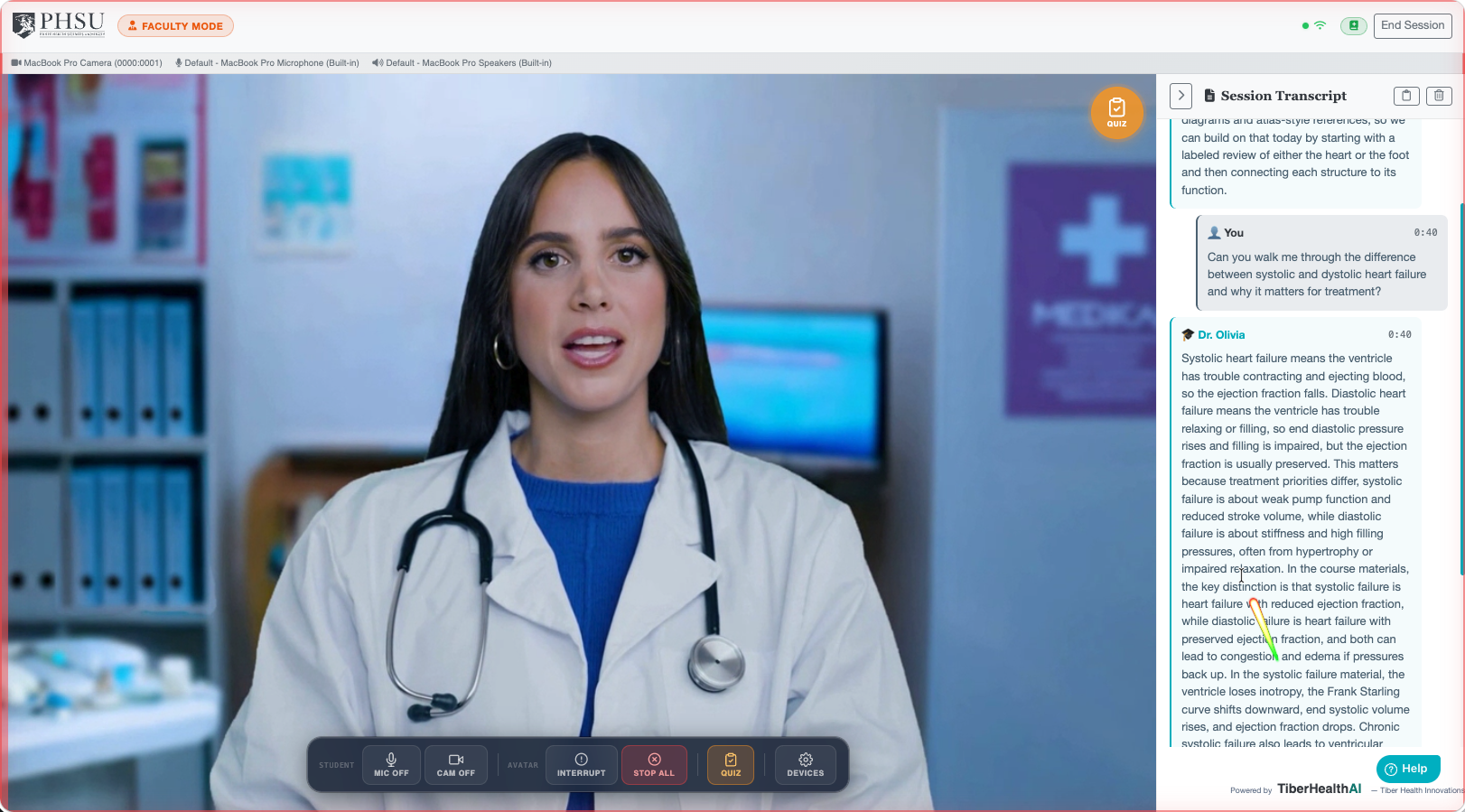
| "Heart failure" | "Can you walk me through the difference between systolic and diastolic heart failure, and why it matters for treatment?" |
| "What is this?" | "I'm looking at a question about beta-blockers in COPD. I'm confused about whether they're contraindicated — help me reason through it." |
| "I don't get it." | "I don't get why renin release goes up when blood pressure drops — can you explain the trigger?" |
| "Tell me everything about the kidney." | "Let's review the nephron one segment at a time, starting at the glomerulus." |
Conversation Patterns That Work
Think out loud
Dr. Olivia teaches by guiding, not lecturing. If you say "I think it's because of X — am I close?" she'll either confirm and add nuance, or steer you toward the right reasoning. Silent right-or-wrong answers don't help her help you.
Ask for one thing at a time
"Explain the renin-angiotensin system" is fine. "Explain the renin-angiotensin system, then quiz me, then compare it to the natriuretic peptides, then draw it" overwhelms a single response. Break it up — she remembers context across the whole session.
Iterate
Don't accept the first answer if it didn't land. Try:
- "Can you explain that more simply?"
- "Give me a clinical example."
- "Compare it to something I already know."
- "Now explain it like I'm a first-year."
Push her back to the book
Dr. Olivia can re-search your textbooks in the middle of an answer, so asking for more depth actually gets you more of your material — not just a longer explanation of the same page. Try:
- "Go a level deeper — what's the actual mechanism?"
- "What do my materials say about this specifically?"
- "Is that in my textbook, or is that general knowledge?"
You don't have to ask her to look things up — she does it on her own when the conversation moves past what she started with. If your curriculum genuinely doesn't cover something, she'll say so rather than blurring the line.
Slow her down (or speed her up)
"That's too fast, break it into smaller steps." — or — "Skip the background, jump to the key point." She'll adjust.
Quiz mode
"Quiz me on this until I get five in a row right." Dr. Olivia will hold the quiz state across turns until you say stop.
Questions from the Quiz button are written to NBME standards: a clinical scenario that the answer actually depends on, a focused question you should be able to answer before reading the options, and five alphabetized choices of the same kind — each wrong one built from a misconception students really hold. After you answer, you get the reasoning for the correct choice and for every distractor, so a question you miss tells you which wrong model you were holding.
Faculty note: the interactive quiz overlay is a student feature, so the Quiz button is hidden when you're signed in as faculty. You can still ask Dr. Olivia to write practice questions — she'll lay them out inline in the conversation for you to review or copy rather than launching the timed student quiz.
Voice vs. Text
- Voice (avatar): faster for back-and-forth, better for quiz-me sessions, better for thinking out loud. She handles natural pauses and hesitation.
- Text: better when you want a written record, when you're in a quiet space, or when she's drawing complex diagrams you want to study at length. Markdown formatting makes complex answers easier to scan.
What She Won't Do
- Give medical advice. She's an educational tutor, not a clinician. She won't diagnose your symptoms or recommend treatments for real patients.
- Take exams for you. If you paste in a graded exam question and ask for the answer, she'll guide you through the reasoning instead of just giving the letter.
- Pretend to be human. She'll always tell you she's an AI tutor if you ask.
After the Session
When you end the call, you'll get a PHSU-branded summary email with the title of the session, USMLE topics that came up, a short summary, and any images that were generated. The next time you sign in, Dr. Olivia greets you with a personalized continuation that references the previous session.